
Leslie’s Blog
Tips, updates, and stories about accessible communication.
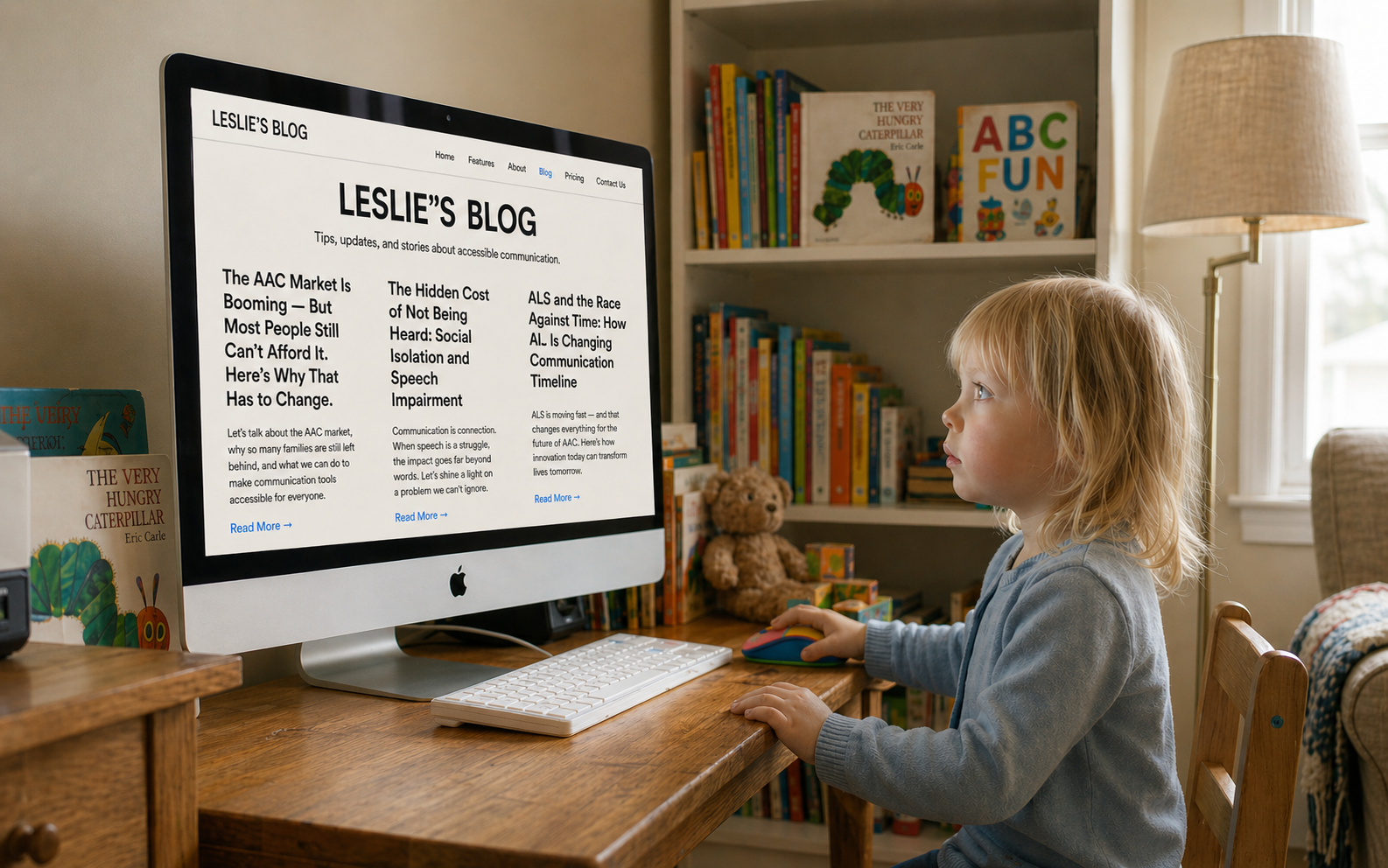
The AAC Market Is Booming — But Most People Still Can’t Afford It. Here’s Why That Has to Change.
The assistive communication technology market is growing fast. The global AAC devices market was valued at $2.09 billion in 2024 and is projected to grow to $3.56 billion by 2029, driven by an aging population, increased smartphone adoption, and rising awareness of…
The Hidden Cost of Not Being Heard: Social Isolation and Speech Impairment
When we talk about speech impairment, we tend to focus on the physical — the mechanics of voice, the technology of communication. What gets talked about less is the emotional and social toll. In a survey of 188 people with Parkinson’s disease, 92.5% reported at least…
ALS and the Race Against Time: How AI Is Changing the Communication Timeline
For people living with ALS, communication is a race against time. As the disease progresses, speech becomes harder, then impossible. The window for capturing a person’s natural voice — their cadence, their personality, their sound — closes fast. As speech…

Why 89% of People with Parkinson’s Lose Their Voice — And What Technology Can Do About It
Most people know Parkinson’s disease affects movement. Few realize how devastating it is to speech. Research has found that speech disorders affect up to 89% of people with Parkinson’s disease — yet despite that staggering number, only 3–4% ever receive speech…
What the Research Actually Says About AAC Phrase Builders — And Why “Requesting” Isn’t Enough
If you’ve ever looked into AAC apps and devices, you’ve probably noticed they all focus heavily on one thing: helping users request objects or actions. “I want water.” “I need help.” “I’m hungry.” Requesting is important. But according to recent research, it’s only a…

The $7,000 Device in Your Pocket: Why Smartphones Are Replacing Dedicated AAC Hardware
For decades, people with speech impairments who needed AAC (Augmentative and Alternative Communication) technology had limited options: expensive dedicated hardware, long insurance approval processes, and devices that could cost thousands of dollars.
Dedicated AAC speech-generating devices can range from simple systems at around $215 to advanced speech-generating systems costing $7,000 or more. Speechpathologygraduateprograms Medicare will typically only fund one every five years. Insurance documentation requirements are extensive and approval is never guaranteed.
But something significant has shifted. According to the National Institute on Disability, Independent Living, and Rehabilitation Research, mobile AAC devices have seen a surge in usage, with 40% more individuals choosing smartphone and tablet-based solutions in the past three years. Business Research Insights
The reason is simple: smartphones are already in people’s hands. They’re familiar, portable, always charged, and don’t carry the social stigma of a medical device. A person using a communication app on their phone looks like anyone else — not like a patient.
Everyday digital technologies such as smartphones and tablets may be used to assist persons with neurodegenerative conditions in performing daily tasks, such as using voice-activated commands to control their environment and text-to-speech to communicate verbally. PubMed Central
The gap between a $7,000 dedicated device and a well-designed $20/month app is closing fast. For many people — especially those in early or mid-stage conditions — a smartphone app provides everything they need at a fraction of the cost, with none of the wait.
Ready to Be Heard?
Download Leslie today and start communicating with confidence.
Leslie
“You can hear me now”
Speech assistance for everyone.
Product
Features
Pricing
Download
How It Works
Support
Contact Us
FAQ
Voice Command List
© 2026 Leslie Speech Assistant. Built with ❤️ for accessibility.